

Labour's earned settlement proposals: destroying a British success story
The proposals confuse immigration policy with citizenship policy. They will harm not help integration.


In response to concerns about high levels of immigration, the Labour government has announced plans to increase the normal minimum period it takes for a migrant to be eligible for settled status from five years to 10 years or longer. These proposals, when implemented, will have a disastrous impact on migrant integration into the society and economy of the United Kingdom. At a stroke, a Labour government will torpedo 75 years of successful integration policy.
There are those on the left and on the right who claim integration policy has not been successful. There is enduring racism and disadvantage, say those on the left. There is persistent cultural difference, say those on the right.
The reality is that there are few countries that have not experienced considerable levels of immigration since the Second World War. On crucial, objective measures of integration such as educational attainment and intermarriage, the United Kingdom has in fact been very successful.
There has been an increase in public expressions of racism in recent years. Shabana Mahmood, the Home Secretary behind these proposals, claims that the changes are necessary to protect migrants and their descendants — people like her — from racism and racist attacks.
I fear that Mahmood confuses immigration with integration.
It is undoubtedly true that there has been a lot of immigration over the last few years, particularly since 2020.
Personally, I have no problem with reducing immigration for study or work, as long as the British state is willing to, for example, fund universities differently and pay care workers more. Reduced immigration comes with costs which would need to be recognised.
But I do have a problem with treating migrants and their children badly in ways which make their lives harder once they are here. It is not just pointless but it actively harms integration, which has long term social and economic consequences. It also creates considerably more work for the Home Office, which already has too much on its plate and should focus more on genuinely important core tasks.
Will the proposals reduce immigration?
The proposals will also have essentially zero impact on the number of migrants arriving in the United Kingdom.
The type of migrant willing to come to the United Kingdom might well be affected. Those with high skills who have a choice of country to which they might relocate might well be deterred from coming here. But the improvement in wealth and opportunity for migrants and their children will mean that however many visas the government is willing to issue will be taken up by someone somewhere.
To change the numbers arriving, the government just has to change the criteria for granting visas. The last government made it far, far easier to qualify for available visas and imposed no cap. Numbers therefore increased. When the criteria for visas were considerably tightened and narrowed, numbers fell again. Dramatically. See the Migration Observatory chart below. The criteria for acquiring settlement has got nothing whatsoever to do with this.
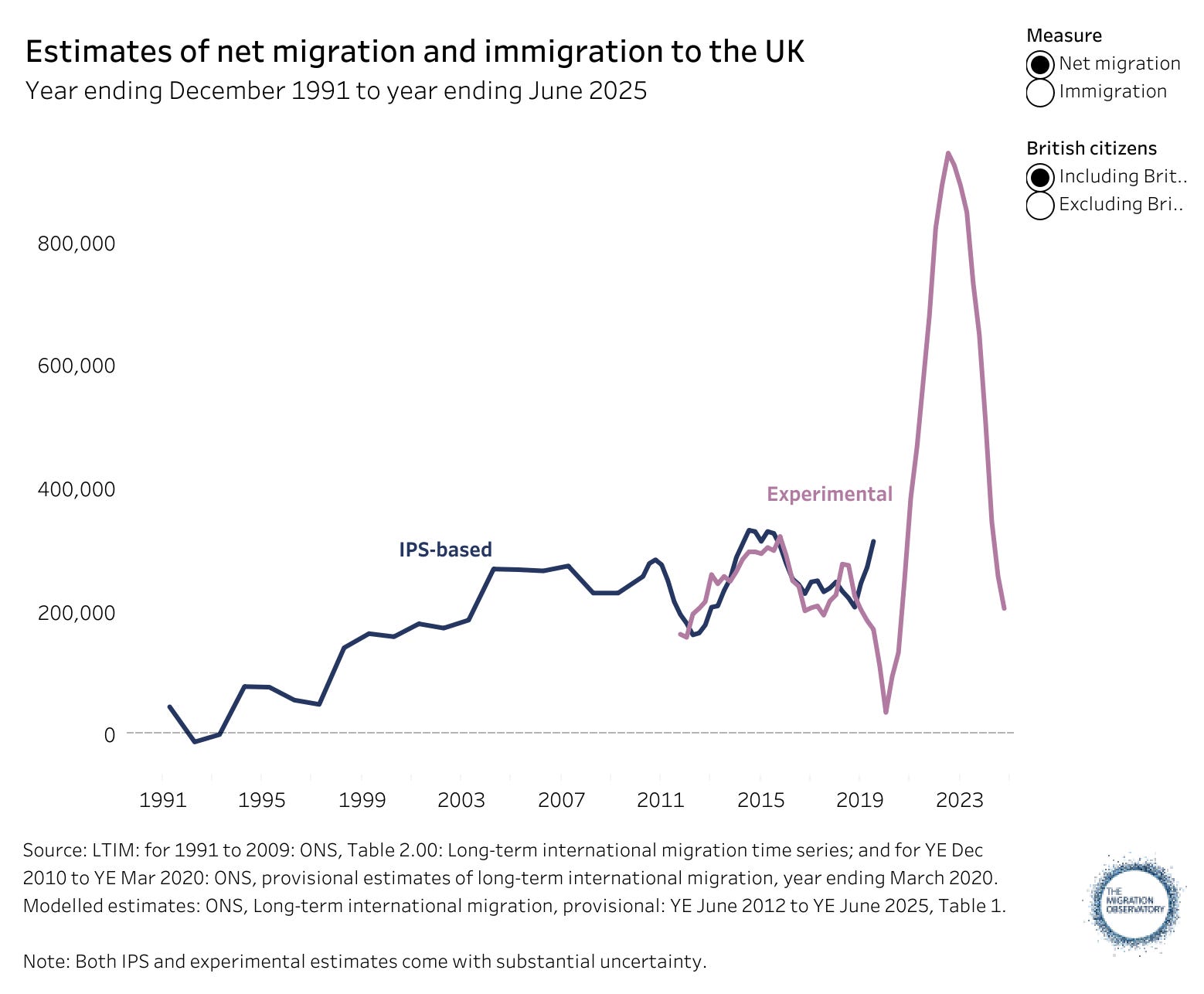
It might be argued — although I have not actually seen this argument being made explicit — that the proposals, when implemented, will force or encourage some migrants to leave the United Kingdom who would otherwise have remained here. If a skilled worker loses their job, they will normally also lose their immigration status. If they cannot afford the high cost of applications, they will lose their immigration status. If they are on temporary immigration status for longer, they are at more prolonged risk of losing their immigration status.
There is some truth in this, so far as it goes. A certain percentage of those on a given form of immigration status will lose their immigration status and/or leave the United Kingdom. But that “and/or” is important. Losing status and leaving the country are not the same thing. A certain percentage of those who lose their immigration status will not leave the country. They will remain here and become part of the unauthorised population. Enforcing their removal is often a violent, traumatic and expensive affair, as we are seeing with the ICE operations in the United States.
So, we might conclude that some migrants who would otherwise have remained in the UK will leave. But also some migrants who would otherwise have remained within the law will instead remain outside the law. I have seen no estimates of either effect.
These earned settlement proposals are really about how migrants are treated when they are here, not about how many come in the first place or how many of them get to stay.
Confusing immigration and citizenship
It looks like 2025 will represent a turning point in UK citizenship policy. Here, I use the word “citizenship” in the wider sense rather than the narrow legal one to which readers of my Free Movement website will generally be accustomed.
Citizenship is about who “we” are.
Citizenship policy is about how “them” become “us”.
Immigration policy is different but related. It is about the admission of “them” to “our” space, our country. It is different to citizenship policy because only a proportionately small number of immigrants will ever become citizens.
Immigration policy is about the conditions for entry. Citizenship policy is about the conditions for staying permanently and becoming part of the host society.
One of the many problems with the Labour government’s approach to citizenship and immigration is that it has confused one with the other.
In the United Kingdom, those who have settled status, formally called indefinite leave to remain, are, in effect, “us”. They have similar rights to actual citizens and will very likely live here the rest of their lives. Their children will automatically be born British citizens.
In a white paper entitled “Restoring control over the immigration system”, the government proposed to lengthen the standard period for an immigrant to settle in the UK from five years to 10 years. This is a change to citizenship policy, not to immigration policy.
Changing the criteria for citizenship cannot possibly have any meaningful effect on the numbers of immigrants. Making citizenship worse or harder to get might conceivably change the type of migrant who comes here. But this would be for the worse, as far as government policy is concerned, because the highest skilled or highest value migrants might well choose to go elsewhere instead.
What will be the impact of the proposals?
The effect the settlement changes will have is that they will delay and undermine the long term integration of those migrants who do come to the United Kingdom.
It will be harder for migrants to get good accommodation and jobs. Every time a migrant goes through a status check, the checker sees just an end date to the migrant’s permission to stay. There is no indication of what visa type the migrant is on or that permission to stay might be extended or what the chances of an extension might be. If you are an employer or a landlord confronted with the stark reality of this end date, it is very tempting to offer the job or tenancy to a person with no such shelf life associated with them.
Migrants will be locked into work visas tied to a specific job for a specific employer for 10 years or more. This is a massive handicap in the job market and it makes them vulnerable to employer exploitation.
The extortionate immigration fees they have to pay mean they and their children will have far, far less money than their peers.
Their children will not be born British citizens, unlike at present.
Migrants will be apart from us in important ways.
And when they do eventually become settled — when they become one of us — the disadvantages they have experienced in the meantime will have lifelong impacts.
Some sort of probationary and transitional period is usually going to be required for some migrants to become settled and citizens. From the coming into force of the Immigration Act 1971 to the present day, that period has generally been five or six years here in the UK. During that time, the UK has also been one of the most successful countries in the world at integrating migrants and their families. That now looks set to change.
How Shabana Mahmood and others think this will reduce racism in society is a complete mystery to me.
—-
The consultation on these proposals is open until 12 February 2026. I have zero hope of the government changing course but it feels like the only thing we can do right now is respond the consultation anyway.
I agree that extending the qualifying period for ILR will do little, if anything, to change how many people come to the UK. You clearly show that immigration numbers are driven by visa rules, not settlement rules.
However, the timing suggests another motive: managing the fiscal impact of the “Boris Wave”. Most visa holders have No Recourse to Public Funds, but this is lifted once they gain ILR. With a likely peak of ILR applications in 2027–28, lengthening the qualifying period looks like a way to delay or smooth a sudden expansion of access to the public purse.
If that is the real rationale, then the government should be more transparent about it, rather than framing the policy primarily in terms of immigration control or protecting migrants, especially given the likely harm to integration that you highlight.
What's also interesting is how the policy rewards high earning workers but penalizes their partner who are say home makers. It's ridiculous to think any skilled high earning worker would risk their life in visa limbo